



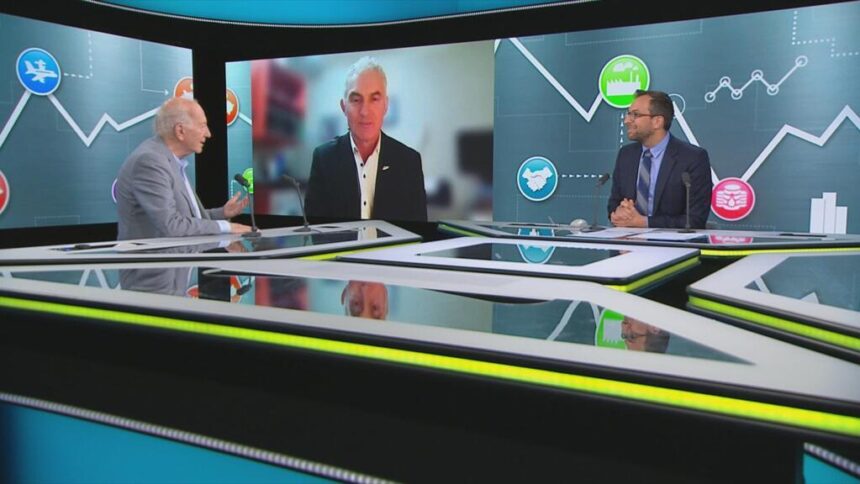
The threat of the president of the United States, Donald Trump, to drag the world of cinema to his commercial wars, has shaken an industry that is still recovering from the closure of COVID-19, Hollywood historical attacks and interruption based on transmission platforms such as Netflix. Will the Angeles end as Detroit, the former global capital of the automotive industry, or will it recover from this crisis? Charles Pellegrin analyzes this and more with Serge Siritzky, a French film producer and expert in cinematographic finance; And Stuart Nash, former Minister of Economic Development of New Zealand. While he was in office, he supervised $ 650 million in cinematographic subsidies to attract huge Hollywood productions such as “Avatar” or “a Minecraft movie.”
Is Hollywood Still the World’s Movie Business Capital?
Hollywood has long stood as the global symbol of filmmaking excellence, storytelling, and entertainment power. From the golden age of cinema in the 20th century to the digital revolutions of the 21st, it has shaped global culture and established itself as the epicenter of the movie industry. But in 2025, with streaming platforms, international film industries booming, and shifting global economics, a pressing question arises:
Is Hollywood still the world’s movie business capital?
Let’s explore this from several angles — economics, influence, infrastructure, innovation, and competition.
1. Economic Power: Still Leading, But Challenged
Hollywood, shorthand for the U.S. film industry (primarily based in Los Angeles), remains the largest film market in terms of box office revenue and investment capacity. The “Big Five” studios — Disney, Warner Bros., Universal, Paramount, and Sony — still dominate global distribution and production budgets. In 2023, U.S.-based studios accounted for a majority share of global box office revenue.
However, the growth rate of Hollywood is slowing compared to rising film markets like:
- China: Already the world’s largest single-country box office in some years
- India: One of the most prolific producers of films
- South Korea: Globally respected for its storytelling and high production values
Verdict: Hollywood is still a financial leader, but it no longer has a monopoly.
2. Global Cultural Influence: Still Strong, But Not Unchallenged
Hollywood movies continue to dominate international screens, thanks to:
- Star power
- Global franchises (e.g., Marvel, Fast & Furious, Avatar)
- Strong visual effects and universal themes
Yet, audiences worldwide are increasingly embracing local storytelling:
- Bollywood films cater to over a billion people and have a massive diaspora appeal.
- Korean cinema (e.g., Parasite, Train to Busan) has gained massive prestige and awards.
- European cinema continues to influence arthouse and indie genres.
- Streaming platforms like Netflix and Amazon Prime now finance and promote international productions from Spain, Germany, Mexico, and Nigeria.
Verdict: Hollywood’s cultural reach is still huge, but the audience is global and no longer solely loyal.
3. Infrastructure and Talent Ecosystem: Still Unmatched
Los Angeles remains a hub of world-class production infrastructure:
- State-of-the-art studios (Warner Bros., Universal, Sony Pictures)
- Top-tier technical professionals (cinematographers, VFX, editors)
- Vast post-production facilities
- Professional unions and guilds that set industry standards
Even with outsourcing and international shooting, major blockbusters often return to LA or Vancouver for post-production or reshoots.
However, countries like the UK, Canada, and New Zealand have built powerful production ecosystems, often benefiting from tax incentives and government support (e.g., The Lord of the Rings, Game of Thrones, and The Witcher).
Verdict: Hollywood still has the densest talent and infrastructure network — but others are catching up fast.
4. Innovation and Technology: Leading, But Not Alone
Hollywood has historically driven innovation:
- The rise of sound and color in film
- Computer-generated imagery (CGI)
- Motion capture and virtual production (used heavily in Avatar and The Mandalorian)
However, technology is becoming more democratized:
- India and Korea are rapidly adopting VFX capabilities.
- China is investing heavily in cinematic tech parks and AI-based post-production.
- Tools like Unreal Engine are allowing independent and foreign creators to match Hollywood’s look on smaller budgets.
Verdict: Hollywood still innovates, but others are innovating too — and sometimes faster.
5. Streaming and Distribution: Globalization Redefines “Capital”
Streaming platforms like Netflix, Amazon, Apple TV+, and Disney+ have changed the definition of a film industry capital.
- Netflix’s content is made in over 50 countries
- Amazon invests in films from Europe, India, and Latin America
- Regional content performs better in many markets than Hollywood films
As a result, power is more distributed. Hollywood studios now compete with Seoul, Mumbai, Berlin, Lagos, and more — not just for eyeballs, but also for creative talent and intellectual property.
Verdict: Streaming has decentralized the movie business — Hollywood is still key, but it’s now one among many hubs.
So, Is Hollywood Still the World’s Movie Capital?
Yes — but with major qualifications.
Hollywood remains the benchmark for big-budget filmmaking, global distribution, technical infrastructure, and cinematic prestige.
It no longer has exclusive control over what the world watches, how films are made, or where money flows.
In a world where Korean thrillers win Oscars, Indian blockbusters break into U.S. box offices, and Spanish TV shows dominate global streaming charts, Hollywood is now part of a much bigger global conversation.
Final Thoughts
The future of cinema is not centralized — it is global, multilingual, and cross-cultural. Hollywood isn’t going away anytime soon, but it must collaborate, innovate, and listen to global voices to maintain its status.
In 2025, Hollywood is still a capital — just not the capital.