



Where Innocence Meets Haute Couture
In a world of fast fashion and child-sized trends that often mimic adult aesthetics, Bonpoint has stood for nearly half a century as a quiet sanctuary of timeless elegance. At the heart of this enduring legacy is Marie‑France Cohen, the visionary who transformed children’s fashion from an afterthought into an art form.
Bonpoint is not just a brand—it is a world. A universe of hand-stitched collars, delicate liberty prints, and whisper-soft cashmere, wrapped in Parisian poetry. For over 40 years, it has dressed the children of royals, artists, and dreamers alike, creating a new language of childhood: one rooted in beauty, grace, and freedom.
At the center of it all is Cohen, a woman whose gentle rebellion reshaped how the world dresses its youngest.
Chapter One: The Birth of Bonpoint
The story of Bonpoint begins in 1975 on Rue de l’Université, in Paris’s elegant 7th arrondissement. Marie‑France Cohen, then a young mother and creative soul, found herself frustrated by the lack of tasteful, well-made clothing for children. At the time, French children’s fashion leaned either saccharine or utilitarian—cartoon motifs, stiff cuts, synthetic fabrics.
Cohen, raised in a family that appreciated the finer things—art, literature, craftsmanship—decided to create what didn’t exist: an haute couture house for children, without the pretense but with all the poetry.
Bonpoint was born out of that vision, with an ethos that elevated childhood without overcomplicating it. Cohen saw children as fully realized individuals with an aesthetic world of their own, deserving of softness, color, and form that didn’t mimic adults, but celebrated their youth.
Chapter Two: A Family Affair
From the start, Bonpoint was deeply personal. Marie‑France ran the brand alongside her husband, Bernard Cohen, who managed operations while she handled design. Their children were often the first models, and friends gathered at seasonal fittings like family.
It was this intimate approach that set Bonpoint apart. Collections were designed like storybooks—each season told a tale, inspired by fairy tales, far-off lands, or Parisian gardens. Pieces were crafted with couture-level attention: hand embroidery, artisanal fabrics, heritage prints, and tailoring usually reserved for adult luxury houses.
“Luxury is not loud,” Cohen once said. “It is something you feel in the fingertips.”
Chapter Three: The Cult of Bonpoint
By the late 1980s, Bonpoint had become a cult favorite among the international elite. Its first boutiques outside Paris opened in London and Tokyo, drawing stylish mothers and celebrities who had grown tired of glittery pinks and logo-heavy infantwear.
The brand’s most iconic location opened in 2006: the Bonpoint flagship at 6 Rue de Tournon, a 17th-century hôtel particulier in Saint-Germain-des-Prés. Here, Bonpoint became more than a brand. It became an atmosphere. A place where children tried on silk-lined coats beside fireplaces, and mothers sipped tea under chandeliers.
Despite its elegance, Bonpoint never lost its warmth. The sales staff knew returning customers by name. The fitting rooms were designed like playrooms. There was always a sense of being welcomed into someone’s home.
Chapter Four: Signature Style, Never Trend
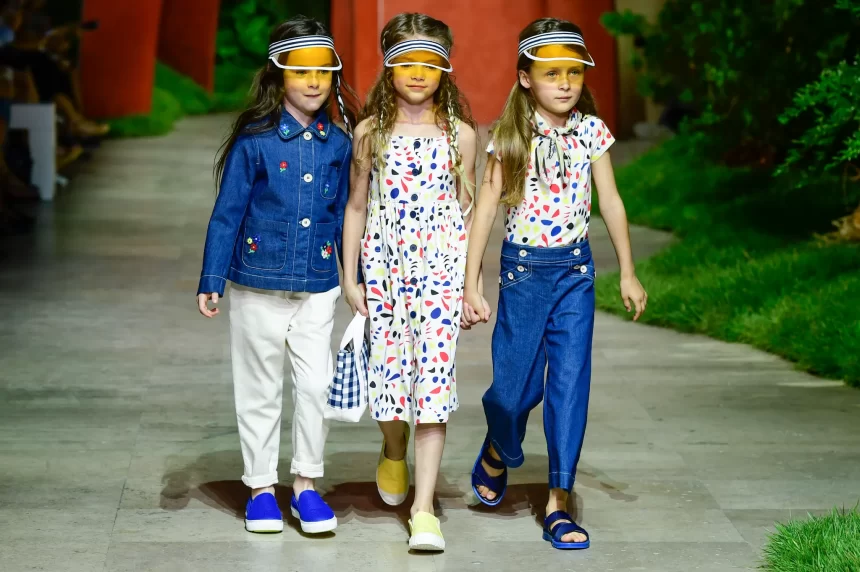
While other children’s brands chased pop-culture relevance, Bonpoint remained defiantly untrendy. Its signature elements—Peter Pan collars, smocked dresses, muted florals, caramel-toned cardigans—formed a vocabulary that transcended seasons.
Each collection embraced a gentle palette: blush, ivory, faded blue, ochre. The silhouettes were modest and timeless. No mini-heels. No faux leather jackets. No slogans.
Bonpoint communicated something quietly radical: children should look like children.
And yet, in its restraint, it became wildly fashionable. Princess Charlotte wore Bonpoint to her first public engagements. Harper Beckham, Suri Cruise, and even North West have all been spotted in its pieces. But Bonpoint never flaunted its clientele—it whispered instead.
Chapter Five: From Fashion to Philosophy
For Marie‑France Cohen, Bonpoint was never just about clothing. It was a philosophy of childhood. A belief in slowing down, savoring texture, making space for magic. It celebrated moments often overlooked: a windblown collar, the rustle of cotton against skin, the curve of a chubby toddler’s arm in a hand-knit sweater.
Cohen believed children absorb beauty intuitively. That surrounding them with care—through clothing, environment, and rhythm—nurtures a gentleness that stays with them for life.
This philosophy extended to Bonpoint’s branding, which avoided brash logos or aggressive marketing. The brand rarely advertised, instead relying on storytelling, word of mouth, and its impeccably designed lookbooks—miniature works of art in themselves.
Chapter Six: A New Chapter – Merci and Maison Cohen
In 2006, after 30 years at the helm, Marie‑France Cohen and her husband sold Bonpoint to a private equity firm. The move marked the end of a chapter—but not the end of Cohen’s creative journey.