

A Rugby Brain with a Philosopher’s Mind
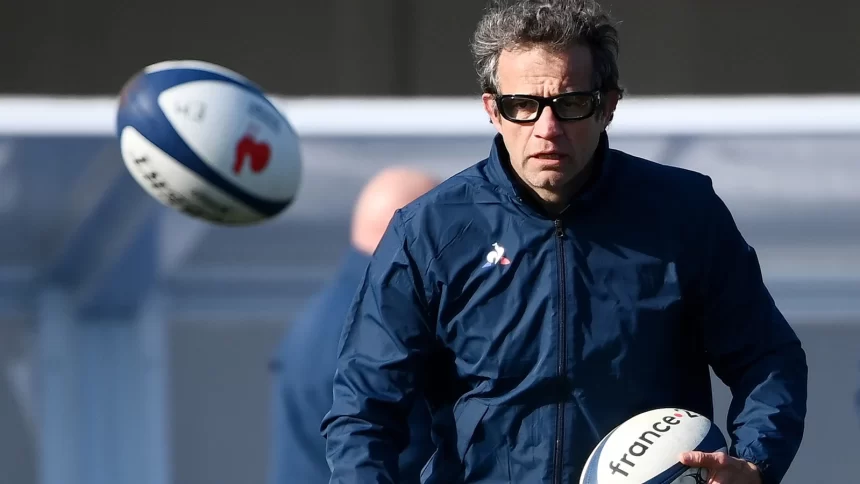
In the high-impact world of international rugby, success often hinges on brute force, physical endurance, and the ability to dominate contact zones. But in Fabien Galthié, the French national team has found something far rarer: a philosopher-coach whose mind operates like a chess grandmaster, plotting patterns, exploiting space, and crafting a game that marries athleticism with intellect.
Since taking over Les Bleus in 2019, Galthié has transformed a once-inconsistent side into one of the most feared and admired teams in the world. With a blend of tactical innovation, psychological acuity, and deep-rooted rugby wisdom, he has led France through a renaissance—one that respects tradition but embraces modernity.
His revolution hasn’t just been about winning; it’s been about rethinking how rugby is played, coached, and understood in France.
Chapter One: From Scrum-Half to Strategic Architect
Before he ever held a clipboard, Fabien Galthié was a formidable player. As a scrum-half, he earned 64 caps for France between 1991 and 2003, captaining the side and bringing a cerebral approach to the game. His style was precise, efficient, and often unpredictable—a foreshadowing of the coaching philosophy he would later develop.
Post-retirement, Galthié dabbled in media commentary and club coaching, with stints at Stade Français, Montpellier, and Toulon. But it was clear that his true calling was not just tactical, but transformational—he wanted to rewire how teams think.
In 2019, with France facing a decade-long drought of Six Nations titles and a fragmented player pool, the French Rugby Federation turned to him not as a last resort, but as a calculated gamble. They needed a visionary. Galthié promised nothing less than a cultural shift.
Chapter Two: The Tactical Renaissance
Galthié’s first move as head coach wasn’t to overhaul the lineup—but to map its potential. He built detailed data systems, tracking every player’s performance across leagues and training camps. His staff included statisticians, psychologists, and even former fighter jet pilots to help analyze decision-making under pressure.
From the beginning, Galthié championed a style that combined fluidity and structure, a French take on Total Rugby. He encouraged risk within frameworks—structured spontaneity. “Freedom in structure,” he called it. The goal was clear: keep the ball alive, play fast, and always find space.
He demanded backs who could tackle like forwards, and forwards who could pass like backs. He placed enormous trust in young players, building a new core around talents like Antoine Dupont, Romain Ntamack, Cameron Woki, and Gaël Fickou—players who weren’t just strong, but smart.
“We do not impose rugby. We propose it,” Galthié famously said. “The game must be lived as a conversation, not a command.”
Chapter Three: The Dupont Era – Speed, Precision, Genius
If Galthié is the philosopher, Antoine Dupont is his poet. Under Galthié’s system, the Toulouse scrum-half has blossomed into the most complete player in the world—a playmaker whose vision, footwork, and physicality are unmatched.
Galthié restructured France’s attack around Dupont’s instincts. Rather than rigid patterns, the playbook became modular—adapting in real-time to flow, positioning, and momentum. France became unpredictable but coherent, aggressive yet controlled.