


From Champion to Coach—A New Kind of Trailblazer
Amélie Mauresmo is no stranger to pressure. As a Grand Slam champion and former World No. 1, she once bore the weight of an entire nation’s expectations on the tennis court. Now, years after retiring from professional play, she thrives in a different kind of spotlight—as one of France’s most respected and visionary tennis coaches.
In an arena still largely dominated by male leadership, Mauresmo has not only broken barriers—she has reshaped them. Her journey from elite athlete to elite coach reveals not only the evolution of her personal career but also a shift in the culture and psychology of French tennis.
“I never wanted to just echo what’s been done,” she says. “My role is not to repeat—it’s to rethink.”
And rethink she has.
2. The Athlete’s Advantage
Mauresmo’s ascent in the coaching world didn’t come out of nowhere. Her tennis pedigree is beyond reproach: two Grand Slam titles (the 2006 Australian Open and Wimbledon), a total of 25 WTA titles, and a tenure at World No. 1. But what set her apart even as a player was her cerebral approach to the game—an ability to anticipate, adapt, and recalibrate in real time.
Those same mental strengths—spatial awareness, strategic planning, and emotional control—translated seamlessly to coaching. Early in her post-retirement years, she began working with juniors at the French Tennis Federation, quietly honing her skills as a teacher and motivator.
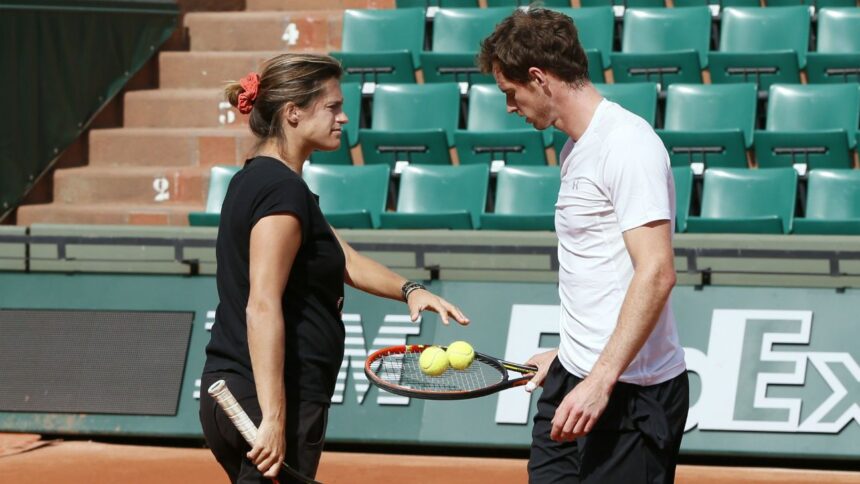
By 2014, she made headlines again—this time not for her backhand, but for coaching one of the world’s most high-profile male players: Andy Murray. The decision stunned the tennis world, both for its boldness and its implications.
Mauresmo was one of the first women in modern tennis to coach a top-ranked male athlete. Murray, known for his outspoken feminism, didn’t see it as risky—he saw it as essential.
“She brings a lot of experience, insight, and calm,” Murray said. “She understands the mental side of the game in a way few people do.”
3. Coaching With Compassion and Control
Mauresmo’s style defies the traditional coaching mold. She doesn’t shout from the sidelines or micromanage points. Instead, she builds trust—establishing a deep psychological rapport with her players. Whether working with seasoned pros or emerging talents, her focus remains the same: self-belief, tactical clarity, and emotional resilience.
“She listens before she speaks,” one former player noted. “With Amélie, coaching isn’t just about hitting drills—it’s about understanding what you’re feeling at 4-4 in the final set.”
This emotional intelligence became especially apparent during her tenure with the French Davis Cup and Fed Cup teams. Under her guidance, France reached the finals of the Fed Cup in 2016. More importantly, she helped build a culture of mutual respect and collective strength—moving away from ego-driven squads toward unified, balanced teams.
4. Developing the Next Generation
Since stepping into more formal leadership roles within the French Tennis Federation (FFT), Mauresmo has championed youth development. She works closely with coaches across the national academy system, scouting promising talent and mentoring up-and-coming stars.
Her philosophy emphasizes versatility over specialization. “You don’t create champions with cookie-cutter programs,” she says. “You create them by teaching how to adapt, how to think.”
Mauresmo encourages young players to train across surfaces, mix up playing styles, and explore their mental limits. She has also advocated for improved support systems for young female athletes, including nutrition, mental health, and injury prevention programs—areas she felt were underdeveloped during her own early career.
5. Breaking the Coaching Glass Ceiling
Amélie Mauresmo’s role in tennis isn’t just defined by her results—it’s amplified by her status as a pioneer. In 2022, she made history yet again, becoming the first woman ever appointed tournament director of Roland-Garros, one of the four Grand Slam tournaments. The role is immensely powerful, overseeing everything from player experience to global media to tournament infrastructure.
“I know there are expectations on me—not just to perform, but to prove,” she said during her appointment. “But I’m not here as a symbol. I’m here to work.”
Her tenure at Roland-Garros has already seen innovations: more transparent scheduling processes, expanded coverage of women’s matches, and a refreshed vision for how Grand Slam tennis is presented to fans and media alike.
Critics who questioned her appointment have largely been silenced by the smooth execution and elevated energy of recent tournaments. Her presence is helping to usher in a new era—one where leadership is determined by ability, not gender.
6. Inside the Mauresmo Method
What truly defines Mauresmo as a coach is her meticulous preparation and deep focus on the mental game. Her coaching sessions are built around scenario training—simulating pressure points, shifting momentum, and moments of doubt.
She pushes players to develop internal decision-making tools, often asking them to call their own tactics during practice games.
“She never tells you what shot to hit,” said a young French junior player. “She helps you figure out why you’d want to hit it in the first place.”
Mauresmo also maintains an open feedback loop, where players are encouraged to analyze their performance beyond wins and losses. In her system, reflection is as important as repetition.
7. The French Tennis Renaissance
Mauresmo’s influence comes at a pivotal time for French tennis. After a golden generation that included players like Jo-Wilfried Tsonga, Gaël Monfils, and Marion Bartoli, France is rebuilding. The FFT has been focused on not just developing players, but modernizing its entire ecosystem—from coaching certifications to digital tools and player tracking.
At every step of that process, Mauresmo is involved. She believes the future of French tennis depends on coaching culture, not just individual talent.
“We have the athletes. What we need is continuity of vision,” she explains. “You can’t build champions in isolation. You need structure, empathy, and evolution.”
8. Beyond the Court
Off the court, Mauresmo remains a powerful voice for equality and inclusion. Openly gay in an era when few athletes were willing to speak about their identity, she has consistently used her platform to support LGBTQ+ rights and combat sexism in sports.
She supports initiatives for women in coaching, and often mentors younger female coaches coming through the ranks in both tennis and other sports. In interviews, she’s candid about the challenges she faced—and the responsibility she now feels to create better pathways for those who follow.
“You can’t be what you can’t see,” she says. “So I try to be visible. But I also want to be effective.”
9. A Legacy in Progress
Though still early in her coaching and leadership career, Amélie Mauresmo has already left an indelible mark. She has changed the language of coaching in France—from one of domination to one of dialogue, from rigidity to responsiveness. She has proven that leadership in tennis doesn’t require volume—it requires vision.
For her players, she’s a guide. For the sport, she’s a force of nature with quiet intensity. And for young women dreaming of careers in sports beyond the court, she’s living proof that glass ceilings are made to be broken.
10. What’s Next?
Looking ahead, Mauresmo is expected to continue shaping the trajectory of French tennis—possibly even taking a more prominent role in Olympic preparation or national team strategy as Paris 2024 looms.
Whether coaching at the baseline or steering the policies of a Grand Slam, one thing remains clear: Mauresmo’s mindset is fixed not just on winning matches—but on redefining what success means in modern tennis.
As she once said to a room of young coaches:
“If we train players to win points, we win games. If we train players to think, we win futures.”