



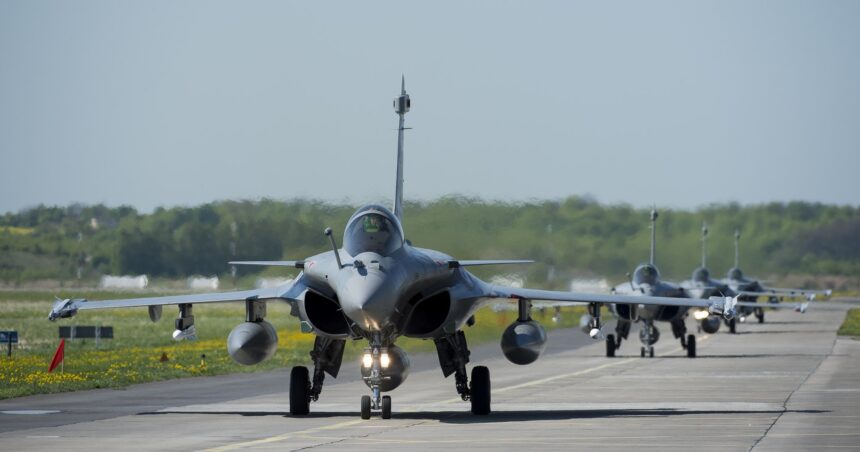
In a move that underscores growing tensions in Eastern Europe, France has deployed three Rafale fighter jets to Poland in response to a recent wave of Russian drone incursions over Polish airspace. President Emmanuel Macron announced the decision via his account on X, stressing that the security of the European continent remains a top priority, and vowing that France will not yield to Russia’s “increasing intimidation.”
What Sparked the Deployment
Earlier this week, Polish military authorities reported that numerous drones had crossed into their territory during Russian attacks on neighboring Ukraine. The incursion was significant multiple “hostile objects” violating Polish borders triggered alarm and forced Poland to respond alongside its NATO allies. In reaction, Poland invoked NATO’s Article 4, which allows member states to request consultations when they perceive threats to their territorial integrity, sovereignty or security. This invocation shows just how serious Warsaw views these incursions. It was, for many, a clear signal that these were not isolated incidents but part of a broader pattern.
France’s Move
What It Entails announcement confirmed that the three Rafale jets were already on their way some reports say they had arrived even before the most recent drone crossings. Their mission: to reinforce Poland’s air defences and bolster NATO’s eastern flank. These Rafales are highly capable multi‑role fighter jets made by Dassault, equipped for air superiority, ground‑attack, and surveillance duties. Their presence is less about engaging directly (so far) and more about deterrence: signaling that NATO is alert and ready. Macron’s message was firm: The European collective defence system is not optional, and threats especially those that test vulnerabilities must be met with resolve. “We will not give in to Russia’s growing intimidation,” he said.
Wider NATO Reaction & Implications
Poland did not face these incursions alone. Other NATO nations quickly expressed solidarity. Germany increased patrols to help defend Poland’s airspace. A bunch of countries called in the Russian ambassadors to complain. Poland also wants an emergency UN Security Council meeting because they think Russia totally broke their airspace and messed with their independence. Experts are saying this whole thing shows how wars are changing. Cheap drones are a pain for old-school defense systems, which are made for missiles and planes, not tons of little drones buzzing around.
Why This Is a Big Deal
For Poland, this isn’t just some random safety problem. It’s about feeling safe as a country, trusting its friends, and believing that borders mean something. Seeing France send fancy jets to protect their skies makes a lot of people in Poland feel safer in a dangerous area.
It shows NATO can move beyond pledges. For France, this is also a statement: that its defence policy will not retreat in the face of what it sees as Russian provocations. Macron’s stance is part of wider French policy that seeks strategic autonomy but also a strong, reliable role in European security. For NATO, it’s another test of its deterrence credibility and coordination. Is the alliance ready for newer forms of threat? Can it handle everything from talking things out to sending in the troops or using anti-drone tech?
Final Thoughts
There aren’t any simple solutions right now. But this whole thing proves that being allies still matters both as a statement and for real support. When France sent Rafale fighter jets to Poland, it wasn’t just about the planes; it showed strength and unity, and reminded everyone that helping each other when a country’s freedom is at risk is part of being in a group of nations.
Now, it all comes down to how we deal with this moving forward: making defenses stronger, making sure those who break the rules are punished, and keeping things from turning into a full-blown war. The stakes are high for Poland, France, and NATO and everyone’s paying attention.