



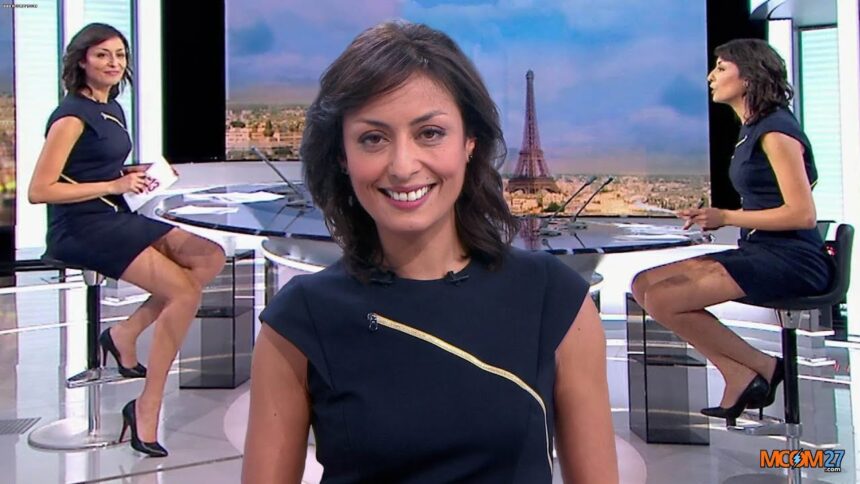
The Voice That Carries Further Than Headlines
For millions of French viewers, Leïla Kaddour is a familiar, composed presence on national television—anchoring weekend news with elegance, clarity, and gravitas. But beyond the screen, Kaddour’s work carries a mission that goes deeper than reciting daily events: she’s become a bridge between France’s elite media institutions and the silenced corners of its republic.
Born to Algerian immigrant parents and raised in the working-class suburbs—the banlieues—Kaddour understands intimately the gulf that exists between national narratives and neighborhood realities. And rather than forget where she came from, she’s made it her life’s work to bring those voices forward.
“I wasn’t supposed to be here, they said,” she once remarked. “So I made sure I brought others with me.”
Today, Kaddour is not just a presenter—she is a platform builder, a mentor, and one of the most impactful cultural figures advocating for youth in France’s marginalized zones.
2. From the Margins to the Mainstream
Leïla Kaddour’s ascent to national recognition wasn’t a typical French media story. After studying literature and media at university, she began her career on France Inter, then France 2, eventually becoming the second woman of North African origin to host the national evening news on a major French channel.
While her talent and professionalism propelled her forward, Kaddour often faced unspoken biases. She was frequently reminded—implicitly or overtly—that she was not the archetype of the “national anchor.” Her diction, dress, and even her background were scrutinized more than her colleagues’. But instead of conforming, she chose to remain rooted in the identity and communities that shaped her.
Her unique background has given her an edge—not just as a journalist, but as a cultural translator. Kaddour knows how to speak to different Frances: the metropolitan elite, the immigrant working class, the disenfranchised youth, and the hopeful dreamers alike.
3. Championing the Voices from the Banlieues
The French banlieues—suburban districts often associated with poverty, immigration, and unrest—are frequently covered in the media, but rarely heard from. Coverage often focuses on crime, riots, or radicalization, while ignoring daily life, creativity, or resilience.
Kaddour is determined to change that narrative.
Using her platform and public visibility, she has launched initiatives to spotlight young voices from the banlieues. From community journalism workshops to youth-led radio segments and school mentorship programs, she has become a powerful advocate for representation.
She regularly visits high schools and community centers in the suburbs to talk about media literacy, storytelling, and how young people can seize the power of their own narratives.
“These kids aren’t voiceless,” she says. “They’ve just been unheard.”
4. Journalism as Empowerment
Kaddour believes journalism should be a tool for democracy—not just a mirror for the powerful, but a window for the excluded. That conviction has led her to host special programming dedicated to exploring identity, exclusion, and civic participation.
She’s produced and moderated town halls with young banlieue residents in Saint-Denis, Clichy-sous-Bois, and Mantes-la-Jolie, focusing on issues ranging from police violence to employment discrimination, from language barriers to artistic expression.
What sets her apart is her deep listening. She doesn’t lecture. She doesn’t patronize. She elevates.
Kaddour often invites young writers, poets, rappers, and local activists to speak in spaces typically closed to them—on national broadcasts, in mainstream cultural panels, or inside national media institutions. Her approach: if the gate won’t open, build a new one.
5. Battling Media Stereotypes from Within
The French media has long struggled with issues of diversity—both in front of and behind the camera. While representation has improved slowly, structural inequality remains entrenched. Newsrooms are still largely composed of graduates from elite Parisian schools, rarely reflective of the multicultural makeup of France.
Kaddour, now one of the few high-profile journalists of North African descent in prime-time media, uses her visibility to challenge internal culture.
She has called out newsroom bias, criticized tokenism, and openly discussed how the media frames stories about minorities. Her interventions are not angry outbursts—they are calmly delivered truths that hold institutions accountable.
In one now-famous internal meeting, after a colleague questioned the editorial relevance of featuring a youth activist from Seine-Saint-Denis, Kaddour responded, “If we never show them unless they burn cars, we are not reporters—we are fire chasers.”
6. Nurturing Cultural Expression
Beyond the newsroom, Kaddour is also deeply involved in the cultural life of the banlieues, promoting literature, music, and the arts as vehicles for expression and change. She regularly collaborates with local festivals, book fairs, and performance collectives.
One of her signature initiatives is “Micro Ouvert” (Open Mic), a partnership between public broadcasters and neighborhood libraries that gives young poets, rappers, and spoken word artists from underserved areas a platform to perform and be recorded professionally.
She also supports scholarships for media students from underrepresented backgrounds, and mentors aspiring journalists, particularly young women of color, helping them navigate an industry where they are still often perceived as exceptions.
7. Redefining What It Means to Be French
Leïla Kaddour’s presence on national TV is itself a quiet revolution. For many French youth of immigrant backgrounds, seeing someone who looks like them, speaks their truths, and understands their world in a position of authority redefines the boundaries of belonging.
She does not frame her success as assimilation. She frames it as expansion—of what it means to be French, of whose stories are worthy of telling, and of who gets to speak into the national microphone.
In her own words: “I am not an ambassador. I am a mirror. France is already diverse. I just reflect what’s already true.”
8. Navigating Backlash
With visibility comes criticism—and Kaddour has received her share. From right-wing commentators accusing her of promoting “identity politics,” to online hate groups targeting her heritage, she has endured relentless pressure.
But she remains composed, refusing to be baited into divisive rhetoric. Instead, she returns to her values: dialogue, dignity, and public service.
Her resistance is not loud. It is principled. She doesn’t shout back—she keeps showing up, keeps mentoring, keeps lifting voices. That, she believes, is the most powerful response.
9. Looking Ahead: A New Generation of Storytellers
Today, thanks in part to her efforts, a new generation of journalists and media creatives from the banlieues are emerging. They are launching podcasts, online news outlets, and visual storytelling platforms that are redefining French media from the grassroots up.
And behind many of them is a word of encouragement, a phone call, or a moment of belief from Leïla Kaddour.